The Gordian Knot: Sword, Shrewdness, and Its Enduring Legacy
The whisper of ancient prophecies, the allure of vast empires, and a knot deemed "unsolvable" – these are the threads that weave together the compelling legend of the Gordian Knot. It's a tale that has captivated minds for millennia, not merely for its historical intrigue but for the powerful metaphor it continues to offer. The pivotal question that echoes through time is:
Wer Löste Der Legende Nach Den Gordischen Knoten? According to legend, the individual who boldly confronted and ultimately "solved" the Gordian Knot was none other than Alexander the Great, marking a turning point in his epic conquest and solidifying his place in history as a leader of unparalleled decisiveness.
Unraveling the Origins: A Chariot, a King, and a Prophecy
To truly appreciate the legend, we must journey back to ancient Phrygia, a kingdom located in what is now modern-day Turkey. The story begins not with a warrior, but with a humble farmer named Gordios. As fate would have it, an ancient oracle had declared that the next man to enter the city of Gordion in an ox-cart would become Phrygia's king. Gordios, arriving by chance in such a manner, ascended to the throne, founding a dynasty.
In an act of gratitude and reverence, King Gordios dedicated his humble ox-cart to Zeus, fastening it with an elaborate, intricate knot. This was no ordinary knot. According to the legend, it was fashioned from cornel bark, so complexly tied that its ends were impossible to discern. It was designed to bind the chariot's yoke to its pole in an "unbreakable" fashion, a symbol of Gordios's divine appointment. But the knot soon took on an even grander significance. A new prophecy emerged, declaring that whoever could untie this seemingly impossible knot would be destined to rule all of Asia.
Over years, many clever and strong men attempted to unravel the Gordian Knot. Scholars, strategists, and ambitious leaders meticulously studied its twists and turns, hoping to decipher its secret. Yet, none succeeded. The knot remained a stubborn enigma, a tangible symbol of an insurmountable challenge, waiting for its fated solver. It stood not just as a physical obstacle, but as a psychological barrier, instilling doubt and frustration in all who dared to try.
Alexander's Arrival: Confronting the "Unsolvable"
Fast forward to 333 BCE (or 334 BCE in some accounts), a critical juncture in the annals of antiquity. Alexander the Great, the ambitious young king of Macedon, was sweeping through Asia Minor, already proving himself a formidable military genius. His path led him and his army to Gordion, the ancient capital of Phrygia. Alexander, known for his relentless pursuit of glory and his belief in divine omens, was keenly aware of the Gordian Knot legend and the immense prophecy attached to it. Here was a symbolic challenge, a test of his leadership and destiny, that he could not ignore.
Upon seeing the fabled knot, Alexander found himself before the very same "unsolvable" problem that had baffled so many before him. The intricate web of ropes, purportedly tied by King Gordios himself, seemed to defy all conventional attempts at untangling. The air was thick with expectation; his soldiers, local inhabitants, and his own conscience awaited his move. Would he, like all the others, be stymied by this ancient puzzle? Or would he demonstrate the unconventional thinking that would come to define his legendary campaigns?
It was a moment that called for more than just physical strength or logical deduction. It demanded a redefinition of the problem itself. For a deeper dive into his strategic mind, explore
Alexander the Great: How He Conquered the Gordian Knot and Asia.
The Moment of Truth: Sword or Shrewdness?
When facing the Gordian Knot, Alexander the Great was presented with a dilemma: conform to the established rules of engagement and attempt to untie it, or redefine the challenge entirely. The legend, as it has been passed down through generations, offers two primary accounts of how he "solved" it, each reflecting a different facet of his genius.
The Decisive Sword-Stroke
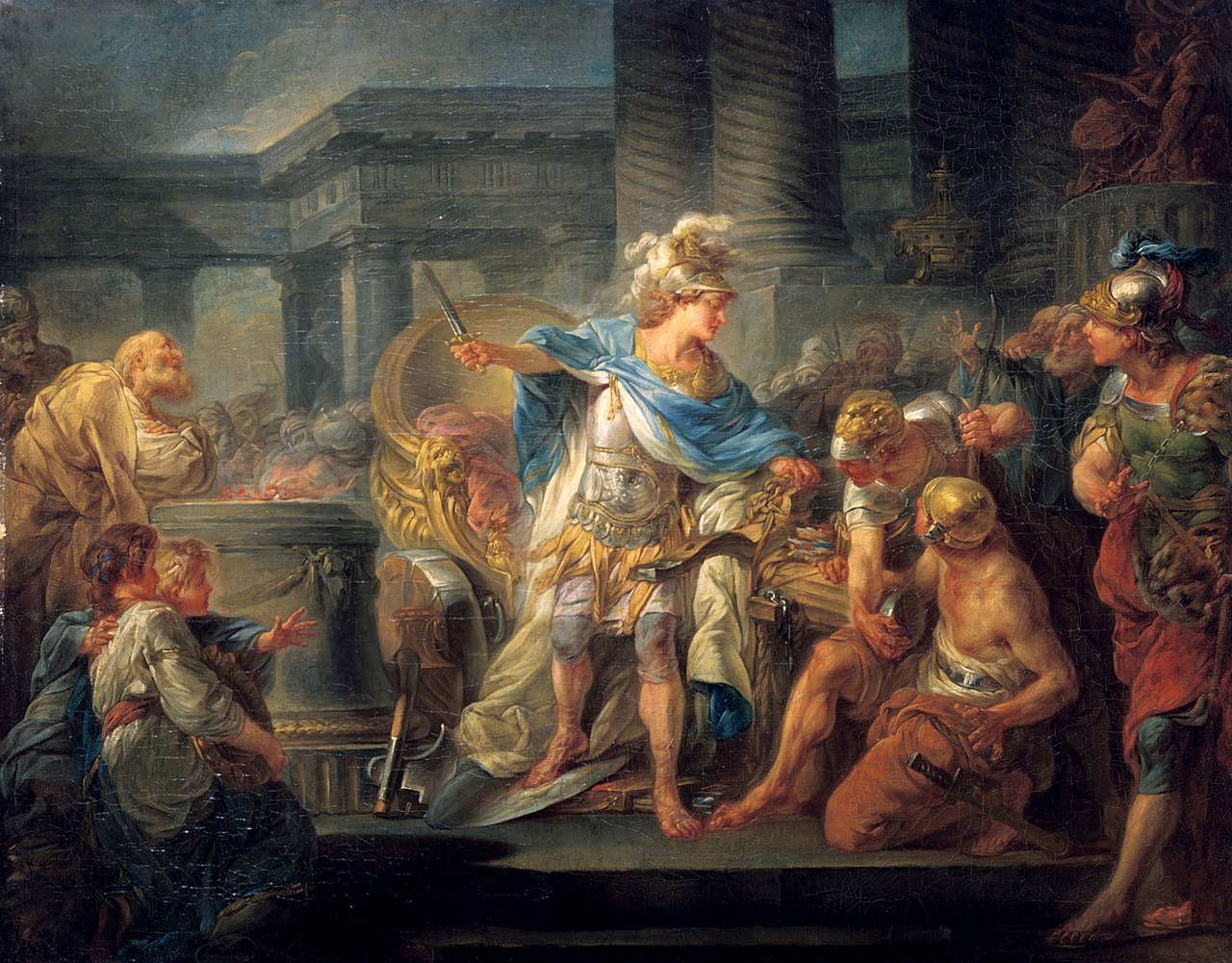
The most famous and widely embraced version of the legend states that Alexander, after carefully examining the knot and perhaps finding no obvious beginning or end, grew impatient with the conventional approach. Instead of attempting the painstaking process of untangling, he declared, "It makes no difference how they are loosed," or words to that effect. With a swift, powerful motion, he drew his sword and cleaved the knot with a single, decisive stroke.
This act was revolutionary. It wasn't about patiently following rules; it was about breaking them. It was a bold, unconventional solution that bypassed the perceived impossibility of the task. By cutting the knot, Alexander demonstrated not only his strength and decisiveness but also his willingness to think outside the box, to challenge assumptions, and to forge his own path to victory. This act was immediately interpreted as a clear fulfillment of the prophecy, a divine endorsement of his destiny to conquer Asia. His subsequent military successes, which saw him indeed become the ruler of a vast Asian empire, only served to cement this version of the story in the popular imagination.
The Clever Pin Solution (An Alternative View)
While the sword-stroke is the prevalent narrative, some ancient sources present an alternative, more subtle account. These tellings suggest that Alexander, rather than resorting to brute force, used his intellect and observation skills. According to this version, he realized that the knot wasn't truly "unsolvable" but simply required a different perspective. He noticed that the intricate windings of the ropes were held in place by a crucial pin or bolt that secured the yoke to the chariot pole. By pulling out this single bolt, the entire knot structure would unravel, allowing him to "loosen" it without cutting.
This version portrays Alexander not as a brute, but as a clever tactician who could identify the root cause of a problem and remove it with minimal effort. It emphasizes ingenuity over raw power, a testament to his shrewdness. However, it is the more dramatic and impactful image of the sword-stroke that has persisted, perhaps because it better encapsulates the idea of overcoming an impossible obstacle through audacious action. Regardless of the exact method,
Alexander the Great, according to legend, unequivocally provided the solution to the Gordian Knot, setting the stage for his legendary conquests across Asia. For more on the prophetic elements, refer to
The Gordian Knot: Ancient Prophecy, Alexander's Blade, and Asia's Fate.
The Enduring Legacy: "Cutting the Gordian Knot" in Modern Times
The story of the Gordian Knot transcends its ancient origins to become a powerful and widely recognized idiom in modern language. To "cut the Gordian Knot" means to solve a complex, seemingly intractable problem with a single, bold, and often unconventional stroke. It’s about decisive action that bypasses traditional, time-consuming, or ineffective methods.
This metaphor is particularly resonant in various fields today:
*
Business and Leadership: Leaders often face "Gordian Knots" – complex challenges where traditional solutions have failed. Cutting the knot might mean a radical restructuring, a disruptive innovation, or a complete pivot in strategy. It encourages daring to challenge established norms and assumptions.
*
Problem-Solving: In any domain, from technology to personal finance, we encounter problems that seem too tangled to untangle. The Gordian Knot metaphor encourages us to step back, reframe the problem, and consider if a direct, albeit unconventional, solution exists.
*
Innovation: True innovation often comes from "cutting the Gordian Knot" – rejecting incremental improvements in favor of breakthrough solutions that fundamentally change the landscape. It's about finding the elegant, simple solution to an overwhelmingly complex system.
Practical Tips for "Cutting Your Own Gordian Knots":
1.
Reframe the Problem: Before you attempt to untangle, ask if you're even asking the right question. Is the problem truly about untangling, or is there a way to make the knot irrelevant?
2.
Challenge Assumptions: Many perceived "impossibilities" are built on unchallenged assumptions. What if the rules you're operating under aren't actually fixed?
3.
Don't Fear Decisive Action: Sometimes, the paralysis of analysis is more damaging than a bold, potentially imperfect, decision.
4.
Look for the "Pin": If the sword isn't your style, emulate Alexander's rumored shrewdness. Can you identify a single, critical leverage point that, if removed or altered, would unravel the entire complexity?
5.
Embrace Unconventional Thinking: The "solution" to your Gordian Knot might not be obvious or follow established protocols. Be open to radical ideas.
The enduring power of the legend lies not just in who solved the Gordian Knot, but in *how* he did it. It taught humanity that sometimes, the most effective way to deal with a seemingly impossible challenge is not to meticulously pick it apart, but to bravely and decisively cut through its core.
Conclusion
The legend of the Gordian Knot and its dramatic resolution by Alexander the Great remains a potent symbol of leadership, decisiveness, and unconventional thinking. When asked, "
Wer Löste Der Legende Nach Den Gordischen Knoten?" the answer is definitively Alexander the Great, whose swift action in 333 BCE not only fulfilled a prophecy but also bequeathed to posterity a timeless idiom. Whether he achieved this through the brute force of a sword or the elegant logic of removing a pin, his solution highlighted a critical principle: that insurmountable problems often require a radical shift in perspective and a willingness to act boldly. The legacy of the Gordian Knot continues to inspire individuals and organizations to face their most complex challenges not with despair, but with the courage to "cut through" to a solution.