Alexander the Great: Conquering the Gordian Knot and Forging an Empire in Asia
The annals of history are replete with tales of legendary figures whose actions not only shaped empires but also left an indelible mark on human culture and language. Among these, few stories captivate the imagination quite like Alexander the Great's audacious encounter with the Gordian Knot. It’s a narrative that intertwines ancient prophecy, cunning strategy, and decisive action, defining a moment that many believe foreshadowed his unparalleled conquest of Asia.
The question,
Wer Löste Der Legende Nach Den Gordischen Knoten –
who solved the Gordian Knot according to legend? – immediately brings to mind Alexander, King of Macedon. His legendary solution to this seemingly insurmountable puzzle has transcended its historical context to become a powerful metaphor for bold problem-solving in the modern world. But what exactly was this mysterious knot, and how did a young Macedonian king manage to unravel – or perhaps, unmake – a challenge that had baffled wise men for centuries?
The Enigmatic Origins of the Gordian Knot in Ancient Phrygia
To understand the significance of Alexander's act, we must first journey back to the heart of ancient Phrygia, a kingdom located in what is now modern-day Turkey. Here, in the city of Gordion, lay the legendary Gordian Knot, an object of immense mystical and political importance. The knot itself was no mere tangled rope; it was a masterpiece of intricate binding, fastening the yoke of a humble ox-cart to its pole. This wasn't just any cart, however. According to Phrygian legend, it belonged to King Gordias, the kingdom's founder, and was dedicated to the god Zeus.
The story of Gordias is equally compelling. He was said to be a simple farmer who, in fulfillment of an ancient oracle, was proclaimed king after arriving in the city with his ox-cart. In gratitude, or perhaps as a divine testament to his kingship, he dedicated his cart, securing its parts with an extraordinarily complex knot. This knot was described as being tied in such an intricate fashion that no ends were visible, making it seemingly impossible to untangle.
The true power of the Gordian Knot, however, lay in an ancient prophecy whispered throughout Asia Minor:
whoever could untie this knot would be destined to rule all of Asia. For generations, many strong and clever individuals had attempted to solve the riddle, but all had failed. The knot remained a symbol of an unfulfilled destiny, a challenge awaiting the truly worthy.
Alexander's Arrival and the Prophecy Fulfilled (333 BCE)
Fast forward to 333 BCE. Alexander the Great, a brilliant military strategist and charismatic leader, was already on a formidable campaign, sweeping through Persia and securing his grasp on vast territories. His ambition was boundless, his vision clear: to conquer the entirety of the Persian Empire and extend Greek influence across the known world. As his armies advanced through Asia Minor, he arrived in Gordion, the capital of Phrygia, encountering the fabled Gordian Knot.
The weight of the prophecy hung heavy in the air. For Alexander, who believed himself to be a descendant of Achilles and destined for greatness, the knot was more than a mere curiosity; it was a divine test, a tangible manifestation of his destiny. If he could solve it, the prophecy would affirm his divine right to rule Asia, providing a powerful psychological boost to his troops and demoralizing his enemies. Failure, however, could be interpreted as a sign of divine disfavor, potentially undermining his authority and campaign.
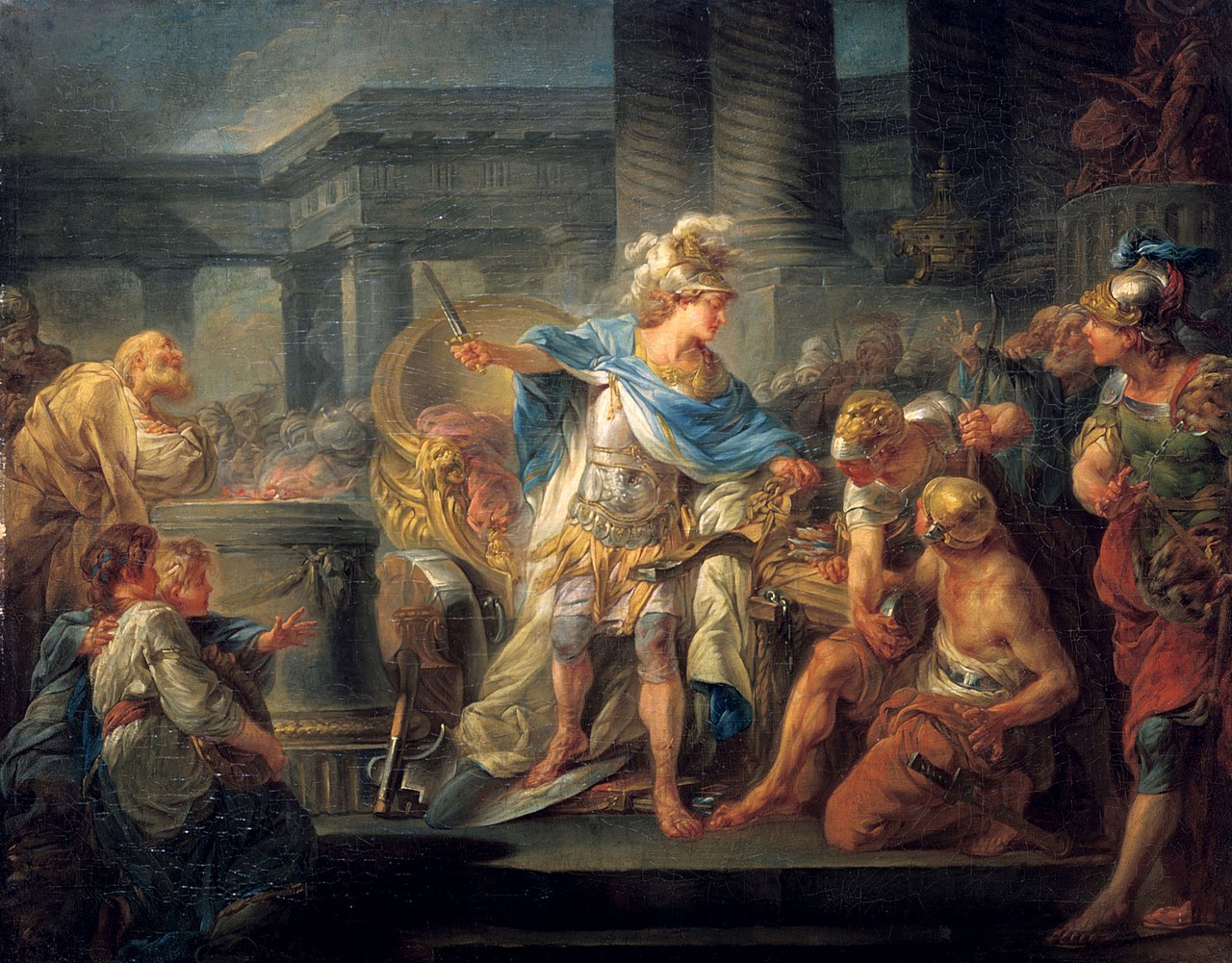
The scene must have been tense. Soldiers, local dignitaries, and scholars gathered, all eager to witness Alexander's attempt. Would he, like so many before him, succumb to the knot's legendary complexity? Or would he forge a new path, demonstrating the kind of decisive leadership required to command an empire?
Two Paths to Mastery: Sword vs. Shrewdness
The legend offers two primary accounts of how Alexander tackled the Gordian Knot, each revealing a different facet of his genius and adding layers to its enduring mystique. Both versions ultimately led to the same outcome: Alexander’s claim to Asia.
1.
The Audacious Sword-Stroke: This is by far the most famous and widely accepted version, the one that has truly cemented the idiom "cutting the Gordian Knot" in popular culture. Frustrated by the knot's apparent insolubility and perhaps impatient with conventional approaches, Alexander reportedly drew his sword and, with a single, powerful stroke, cut the knot in half. When asked how he solved it, he declared, "It makes no difference how they are loosed." This wasn't merely a physical act; it was a profound philosophical statement. It demonstrated a willingness to challenge assumptions, to reject perceived limitations, and to create a solution where none seemed to exist. It epitomized decisive, unconventional thinking, a hallmark of Alexander's military and political genius.
2.
The Shrewd Unraveling: An alternative, though less sensational, account suggests Alexander's solution was one of shrewdness rather than brute force. In this version, Alexander meticulously examined the knot, recognizing that its complexity lay in a hidden pin or bolt that secured the yoke to the pole. By removing this crucial fastener, the entire intricate arrangement of ropes simply fell apart, effectively "untying" the knot without ever cutting it. This version highlights Alexander's intellect and ability to observe, analyze, and find an elegant, albeit unconventional, solution. He didn't break the rules; he found a loophole within them.
Regardless of which version is historically accurate – and scholars still debate this – the outcome was the same. Alexander was hailed as the one who had fulfilled the prophecy. His subsequent military campaigns through Asia, culminating in the defeat of the mighty Persian Empire, only reinforced the belief that the oracle had spoken true. His actions at Gordion served as a powerful omen for his future conquests. For a deeper dive into these contrasting narratives and their implications, you might find
The Gordian Knot: Sword, Shrewdness, and Its Enduring Legacy particularly insightful.
The Enduring Legacy: "Cutting the Gordian Knot" Today
The phrase "cutting the Gordian Knot" has permeated countless languages and cultures, becoming a timeless idiom. It refers to a situation where a complex, seemingly insurmountable problem is solved by a bold, decisive, and often unconventional action, rather than by tedious, step-by-step attempts to untangle it. It's about lateral thinking, challenging norms, and having the courage to take a risk when traditional methods fail.
In the modern world, this lesson from Alexander the Great remains incredibly relevant, especially in leadership, business, and personal development:
-
Challenge Assumptions: Often, problems seem unsolvable because we are bound by predefined rules or perceived limitations. Alexander's act (whether by sword or pin) teaches us to question the underlying assumptions of a problem. Is the knot *truly* untieable, or is the definition of "untying" too narrow?
-
Embrace Unconventional Solutions: Sometimes, the most effective solution is not the most obvious or traditional one. Leaders and innovators are often those willing to think outside the box, to find "third ways" that bypass existing roadblocks.
-
Decisive Action: Over-analysis can lead to paralysis. While careful consideration is important, there comes a point where decisive action is required to move forward. Alexander’s story is a powerful reminder that sometimes, a bold, irreversible step is necessary.
-
Inspire Confidence: Alexander's act at Gordion didn't just solve a problem; it projected an image of powerful leadership and divine favor. For any leader, demonstrating the ability to resolve seemingly impossible situations can inspire immense confidence in their team and followers.
The tale of the Gordian Knot serves as a powerful reminder that history often presents us with metaphors for navigating our own complex challenges. Whether you face a business dilemma, a personal roadblock, or a societal issue, asking yourself "What would Alexander do?" might just encourage you to look for that bold, unconventional solution that lies beyond the obvious. The broader implications of this ancient prophecy and Alexander's audacious act are explored further in
The Gordian Knot: Ancient Prophecy, Alexander's Blade, and Asia's Fate.
In conclusion, Alexander the Great's encounter with the Gordian Knot is far more than a historical anecdote. It's a foundational myth for decisive problem-solving. Whether he cleaved it with his blade or cleverly dismantled it, his action embodied a spirit of leadership that refused to be bound by convention. It cemented his legend, fueled his march across Asia, and continues to inspire us to face our own "unsolvable" problems with courage, ingenuity, and a willingness to challenge the status quo. The legacy of the Gordian Knot reminds us that true mastery often comes not from intricate unraveling, but from a clear, bold vision to cut through the complexity.