The Gordian Knot: Ancient Prophecy, Alexander's Blade, and Asia's Fate
The phrase "cutting the Gordian Knot" has become synonymous with solving an intractable problem through bold, unconventional means. But what is the true origin of this enduring idiom, and who, according to legend, dared to confront a challenge that baffled many before him? This ancient tale intertwines prophecy, power, and the pivotal actions of one of history's most renowned conquerors, forever linking his name to the fate of a continent. Let's unravel (or perhaps, decisively cut through) the layers of this fascinating legend.
The Tangled Web of Prophecy and Power: What Was the Gordian Knot?
Our journey begins in ancient Phrygia, a kingdom located in what is now modern-day Turkey. The story, steeped in myth and prophecy, centers around the city of Gordion and its legendary king, Gordios. According to one account, Gordios was a humble farmer whose life took an extraordinary turn. An oracle had foretold that the next man to enter the city riding in a wagon would become their king. As fate would have it, Gordios arrived in his ox-cart and was proclaimed ruler.
To commemorate his unexpected ascension and as a gesture of gratitude to the gods – specifically Zeus – Gordios dedicated his cart to the deity. He then secured its yoke to the pole with an incredibly intricate knot, one so artfully and ingeniously tied that its ends were completely hidden, making it virtually impossible to untie. This was no ordinary knot; it was a symbol of divine favor and an enigma designed to defy human ingenuity.
The true weight of this knot, however, lay in another, more potent prophecy: whoever could successfully untie this "Gordian Knot" would become the rightful ruler of all Asia. For centuries, this prophecy hung over the region, attracting many ambitious and intelligent individuals who tried, and failed, to unravel its complex design. The knot represented not just a physical challenge, but a symbolic barrier to ultimate power, guarding the very destiny of a continent. Its intricate windings were a testament to human limits, a problem that seemed to defy conventional logic and perseverance.
Alexander's Arrival: The Moment of Destiny
The stage was set for a confrontation between an ancient prophecy and a burgeoning empire. In 333 BCE, a young, ambitious, and already formidable general arrived in Gordion:
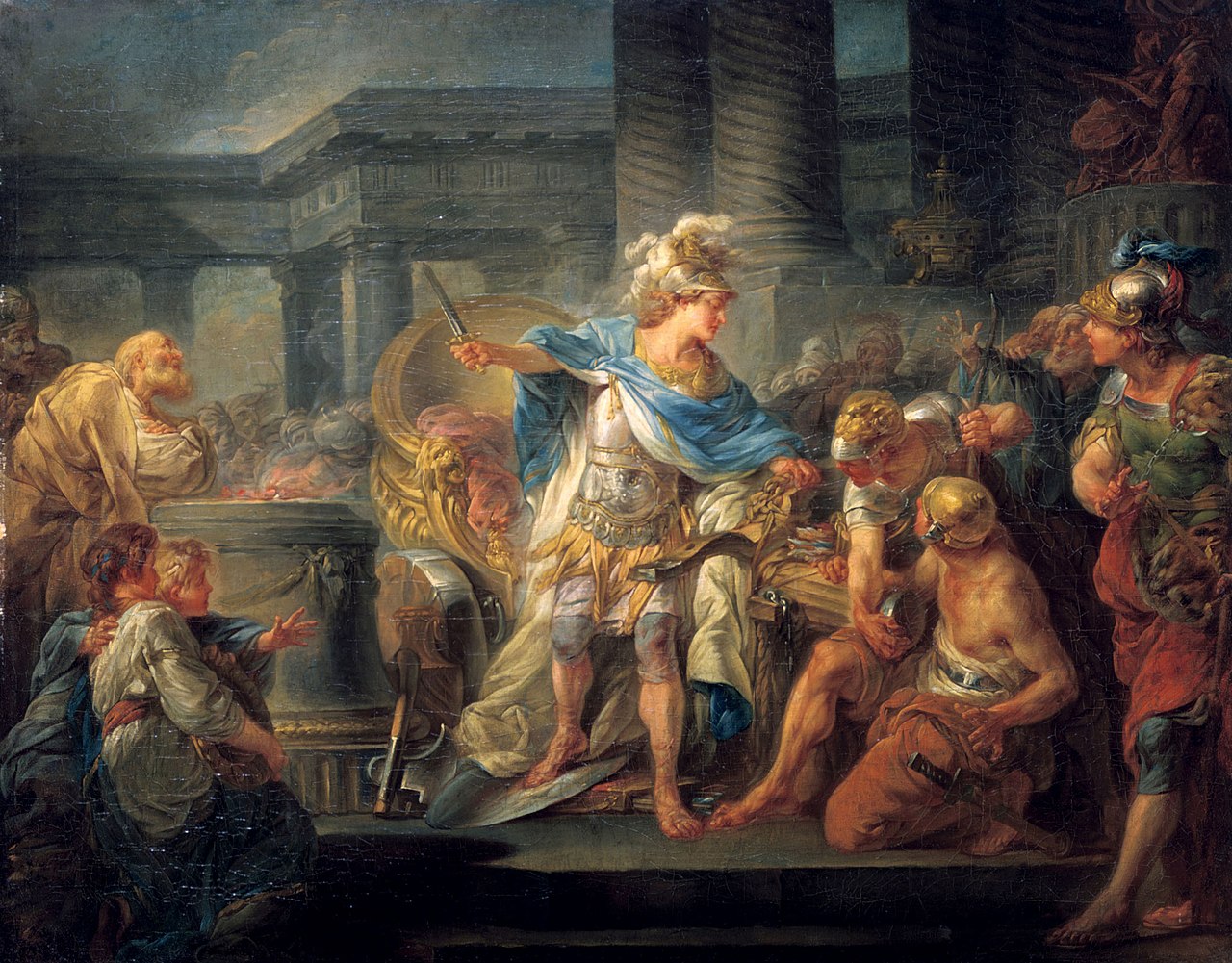
Alexander the Great. Having already demonstrated his military genius and unwavering determination, Alexander faced a different kind of challenge in Phrygia – one that required not a battle plan, but a solution to an enigma. He stood before the fabled Gordian Knot, aware of the prophecy that promised dominion over Asia to its solver. Many had tried before him, scrutinizing its impossible tangles, attempting to find a starting point, only to walk away defeated.
The question that echoes through history,
wer löste der Legende nach den Gordischen Knoten, finds its most celebrated answer in Alexander's dramatic intervention. Faced with a problem that seemed to demand endless patience and meticulous untangling, Alexander famously bypassed convention. Instead of laboriously picking at the knot, he drew his sword and, with a single, decisive stroke, cleaved the knot in two.
This iconic act instantly fulfilled the prophecy, albeit in a manner entirely unforeseen. It wasn't about *untying* but about *breaking* the problem. This bold move wasn't just a physical act; it was a powerful statement about Alexander's approach to challenges – direct, unconventional, and utterly uncompromising. His army and contemporaries, witnessing this extraordinary display of ingenuity and audacity, saw it as a clear sign of divine favor and his destined path to conquer Asia. Indeed, his subsequent campaigns through Persia, Egypt, and into India reinforced the belief that the prophecy had been truly fulfilled.
Interestingly, while the sword-cutting version is by far the most famous and widely accepted, some ancient accounts offer an alternative. These sources suggest Alexander might have employed shrewdness rather than brute force. One version posits that he observed how the knot was constructed and realized that it wasn't one continuous rope but was secured by a central peg or bolt that connected the yoke to the pole. By simply pulling out this peg, the entire "knot" effectively unraveled, exposing the ends of the ropes and thus "solving" it without destruction. Regardless of the exact method, what truly resonated was Alexander's ability to think outside the box and find a solution when others saw only an insurmountable obstacle. The phrase "den Gordischen Knoten durchschlagen" (to cut through the Gordian Knot) became the enduring legacy of his action.
Beyond the Blade: The Enduring Legacy of the Gordian Knot
The tale of the Gordian Knot and Alexander's solution transcends its historical context, evolving into a powerful metaphor deeply embedded in our language and thought. The idiom "to cut the Gordian Knot" signifies overcoming a complex, seemingly insoluble problem with a single, bold, and often unconventional stroke. It's about rejecting conventional wisdom and finding a direct, often radical, solution.
The question,
wer löste der Legende nach den Gordischen Knoten, isn't just about a historical event; it's about the timeless appeal of decisive action and disruptive thinking. In a world often bogged down by bureaucracy, indecision, and analysis paralysis, the spirit of Alexander's act remains incredibly relevant.
Practical Lessons from the Gordian Knot
The legend offers profound insights that can be applied to modern leadership, problem-solving, and personal challenges:
1.
Challenge Assumptions: The primary lesson is to question the premise of the problem. Everyone assumed the knot had to be untied. Alexander asked, "Does it?" In business or life, we often get stuck trying to solve a problem within a narrow framework. Sometimes, the most effective solution requires redefining the problem itself.
2.
Embrace Decisive Action: Alexander didn't procrastinate. Once he decided on his approach, he executed it swiftly and confidently. In situations demanding resolution, endless deliberation can be more damaging than a bold, imperfect solution.
3.
Think Unconventionally: The "obvious" solution isn't always the best one. Alexander's success came from his willingness to disregard established methods. Innovation often stems from looking at a familiar problem through a fresh lens, or from a completely different angle, as perhaps he did with the peg theory.
4.
The Power of Symbolism: Alexander's act was not just practical; it was profoundly symbolic. It solidified his image as a destined leader, capable of achieving the impossible. Leaders today can learn the importance of actions that resonate beyond their immediate impact, inspiring confidence and loyalty.
5.
Risk and Reward: There was a risk in Alexander's approach. Had it failed, he might have been seen as disrespectful or foolish. But his confidence in his method, coupled with the prophecy, paid off handsomely, granting him immense symbolic capital.
Conclusion
The legend of the Gordian Knot, and the resounding answer to
wer löste der Legende nach den Gordischen Knoten, continues to captivate and inspire. Alexander the Great's audacious act in 333 BCE transformed a simple, yet impossible, knot into a potent symbol of decisive leadership and innovative problem-solving. Whether he truly cleaved it with his blade or found a clever workaround, his legacy is one of confronting intractable obstacles head-on, refusing to be constrained by convention, and ultimately shaping the destiny of an empire. The Gordian Knot reminds us that sometimes, the most elegant solution isn't to meticulously untangle, but to boldly cut through the complexities and forge a new path forward.